Choosing between FEP, PTFE, and PFA heat shrink tubing can feel more complicated than it needs to be. All three are fluoropolymers. All three perform well in harsh environments. And on paper, they often look very similar.
The difference is not which material is “better”, but which one fits how your application actually works. Factors such as visibility, temperature exposure, assembly method, and long-term performance usually matter far more than headline specifications.
This guide breaks down the differences in plain terms, so you can narrow down the right option without needing a deep engineering background.
What FEP, PTFE and PFA Heat Shrink Have in Common
Before looking at the differences, it helps to understand what these materials share.
All three heat-shrink materials belong to the fluoropolymer family. That means they are commonly used when standard plastics fall short. Typical reasons include exposure to chemicals, elevated temperatures, or demanding cleaning processes.
In general, FEP, PTFE and PFA heat shrink tubing all offer:
- Excellent chemical resistance
- Stability at high and low temperatures
- Non-stick surfaces
- Long service life in demanding environments
Because of this overlap, material selection often comes down to secondary characteristics rather than basic performance.
When FEP Heat Shrink Tubing Is Often the Right Fit
FEP heat shrink tubing is frequently chosen when control, clarity, and consistency matter.
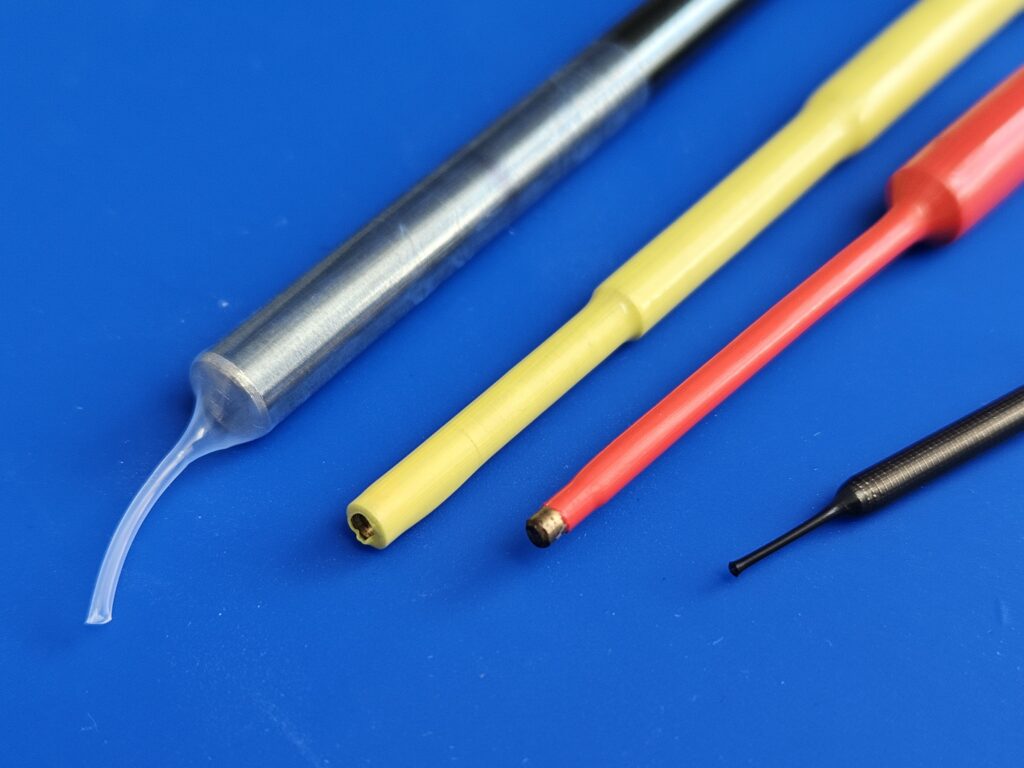
One of its defining features is transparency. FEP allows visual inspection of components underneath the tubing, which is valuable during assembly and quality checks. This makes it popular in medical, laboratory, and electronics environments where visibility reduces risk.
FEP also shrinks in a very controlled way. Rather than aggressively pulling tight, it recovers predictably, making it easier to work with delicate parts or assemblies that require repeatability.
A further advantage of Adtech’s FEP heat shrink range is its relatively low shrink temperature compared to other manufacturers. Our FEP heat shrink is designed to typically recover at around 100 °C, compared to the usual 215 °C required from other sources, which makes it well suited for assemblies containing temperature-sensitive components. This allows heat shrink to be applied without exposing connectors, electronics, or bonded parts to excessive heat during installation.
FEP heat shrink is often considered when:
- Visual inspection of the underlying component is important
- Controlled, even recovery is preferred over aggressive shrink
- The application involves clean or regulated environments
- The tubing is used as part of a manufacturing process, not just protection
In applications involving repeated heating and cooling, FEP also tends to exhibit lower thermal creep than more aggressively shrinking materials. This makes it a stable choice where dimensional consistency needs to be maintained over temperature cycling rather than extreme heat exposure.
Its temperature capability is strong, though not the highest of the three, which is usually acceptable for most assemblies where chemical resistance and clarity are more important than extreme heat.
Where PTFE Heat Shrink Tubing Is Typically Used
PTFE heat shrink tubing is usually selected for more extreme operating conditions.
Compared to FEP, PTFE handles higher temperatures and offers greater mechanical robustness once installed. However, it is opaque and less forgiving during installation. PTFE heat shrink tends to recover more aggressively, which can be an advantage in some applications and a limitation in others.
PTFE is often used where performance outweighs ease of handling or appearance.
Typical reasons for choosing PTFE heat shrink include:
- Higher continuous operating temperatures
- Harsh mechanical or industrial environments
- Long-term exposure where maximum durability is required
- Applications where visibility is not needed
Because PTFE is not melt-processable in the same way as FEP or PFA, it can also bring manufacturing and tolerance considerations that need to be understood early.
Where PFA Heat Shrink Sits Between FEP and PTFE
PFA heat shrink tubing is often described as sitting between FEP and PTFE, both in performance and in cost.
Like FEP, PFA heat shrink can also be applied at significantly lower temperatures than PTFE, making it suitable for use over more temperature-sensitive assemblies while still offering improved thermal performance.
PFA offers improved temperature capability over FEP while retaining better clarity and surface finish than PTFE. This balance makes it suitable for applications that push beyond FEP’s comfort zone but do not require the full characteristics of PTFE.
PFA heat shrink is commonly considered when:
- Higher temperature resistance is needed than FEP can provide
- Some level of transparency is still beneficial
- A balance between performance and manufacturability is required
In practice, PFA is often chosen after experience shows that FEP is close to its limits, but PTFE introduces unnecessary complexity.
Key Questions That Help Narrow the Choice Quickly
Instead of focusing on material names, it is often more useful to think in terms of requirements.
A few simple questions can usually point you in the right direction:
- Do you need to see the component once the tubing is applied?
- Is the tubing exposed to continuous high temperatures, or only short-term heat?
- Does the assembly process require predictable, controlled shrink behaviour?
- Is the tubing part of a manufacturing step or a permanent protective layer?
The answers to these questions tend to eliminate unsuitable options quickly.
How FEP, PTFE and PFA Heat Shrink Are Typically Supplied
Another practical consideration is how these materials are supplied and processed.
Standard sizes are widely available across all three materials, but custom dimensions, wall thicknesses, and shrink ratios can affect lead times and feasibility. Some materials are more forgiving when it comes to tolerances and processing, which can influence cost and delivery.
Understanding this early helps avoid specifying a material that performs well in theory but creates challenges in practice.
Bringing It Back to Your Application
There is no universal “best” heat shrink material. FEP, PTFE and PFA heat shrink tubing each solve different problems, and the right choice depends on how the tubing is used, not just where.
By focusing on visibility, temperature exposure, recovery behaviour, and real-world handling, most applications naturally point toward the most suitable option.
At Adtech, we work with all three materials and help customers align material choice with how their assemblies are actually designed, built, and used—rather than relying on datasheet comparisons alone.
Have a similar requirement? Get in touch