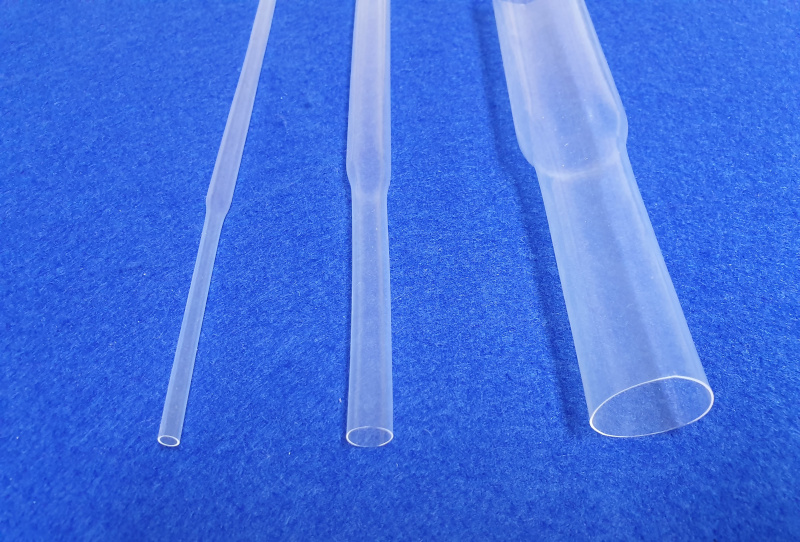
Heat shrink is often selected by material, but the shrink ratio can be just as important.
A component with a straightforward, consistent diameter may only need a small amount of recovery. Components with connectors, steps, joints or slight differences in diameter usually need more flexibility from the sleeve.
This is where 1.6:1 FEP heat shrink can be particularly useful.
It offers more recovery than a lower-ratio sleeve while retaining the temperature resistance, chemical resistance, electrical insulation and transparency associated with FEP.
What does a 1.6:1 shrink ratio mean?
The ratio describes the relationship between the sleeve’s supplied internal diameter and its fully recovered internal diameter.
A 1.6:1 sleeve can recover to approximately 62.5% of its original supplied diameter when correctly heated. This gives engineers more room to fit the sleeve over a wider part before shrinking it onto the narrower section beneath.
The sleeve still needs to be selected carefully. Its supplied diameter must fit over the largest part of the component, while its recovered diameter must be small enough to grip the section that needs protection.
Adtech recommends allowing a generous amount of recovery rather than choosing a sleeve that is already tight before shrinking.
When is 1.6:1 FEP heat shrink useful?
Components with changes in diameter
Many assemblies are not completely uniform.
A cable may include a connector. A probe may have a sensor head. A tube assembly may include a joint, fitting or formed section.
A 1.6:1 ratio can pass over the larger feature and then recover around the narrower part of the assembly. This can reduce the need for separate sleeves or more complicated covering methods.
Temperature-sensitive components
FEP heat shrink has a lower recovery temperature than PTFE heat shrink. Adtech’s 1.6:1 FEP range begins shrinking at approximately 110°C and has a maximum continuous working temperature of 200°C.
This can make it suitable for components that require fluoropolymer protection but could be affected by the higher temperatures needed to recover some alternative materials.
The temperature applied to the complete assembly must still be considered. Sensitive electronics, adhesives, seals and substrates should be checked before any heat-shrink process is approved.
Applications where the component must remain visible
FEP is transparent, allowing the covered area to remain visible after installation.
This can be useful where engineers need to inspect a joint, monitor a sensor, check the position of a component or confirm that the sleeve has recovered evenly.
FEP also provides anti-stick, low-friction, electrical and chemical-resistance properties, which are retained across a broad range of industrial applications.
Sensors, probes and electrical assemblies
FEP heat shrink is commonly used to encapsulate and protect sensors, probes, wiring, connectors and electrical components.
The recovered sleeve can provide an additional barrier against chemicals, moisture and contamination while also supporting electrical insulation.
The suitability of the sleeve will depend on the chemicals, temperatures, pressures and mechanical forces present in the final application.
Prototype and development projects
A standard catalogue size does not always match a new component perfectly.
During product development, the component dimensions may change several times before the design is finalised. A 1.6:1 ratio gives the development team more recovery range to work with while testing the fit and performance of the sleeve.
Adtech can also develop tooling and adapt fabrication processes for prototypes, unusual geometries and bespoke assemblies. This allows the heat-shrink solution to be refined alongside the component rather than added after the design has already been fixed.
What should be checked before specifying the sleeve?
Before selecting a size, confirm:
- The maximum diameter the sleeve must pass over
- The minimum diameter it needs to recover around
- The required wall thickness
- The temperature the underlying materials can tolerate
- The operating temperature after installation
- Exposure to chemicals, solvents or UV
- The required electrical performance
- The expected movement, flexing or abrasion
- The tolerances of both the sleeve and the component
The final choice should be based on the complete assembly rather than the nominal diameter of one section.
Standard, light-wall and heavy-wall options
Adtech’s 1.6:1 FEP heat shrink is available in standard, light-wall and heavy-wall options.
The standard range provides a balance between flexibility and protection. Light-wall sleeving can be useful where space is restricted or a thinner finished profile is needed. Heavy-wall sleeving provides a thicker barrier where greater physical protection is required.
Adtech lists standard FEP 1.6:1 sizes and can advise where a custom size or modified component would provide a better result.
Choosing the right solution
A higher shrink ratio is not automatically the better choice.
The correct ratio is the one that can pass over the largest feature, recover securely around the smallest section and perform reliably within the operating conditions of the finished assembly.
For components with stepped diameters, sensitive materials or unusual geometries, 1.6:1 FEP heat shrink offers a useful balance between recovery, fit and fluoropolymer performance.
Adtech’s technical team can review the component dimensions, application conditions and required finish before recommending a standard sleeve or developing a bespoke solution.
Have a similar requirement? Get in touch