Rollers appear in a huge range of manufacturing processes, from printing and paper converting to food production, automotive manufacturing and increasingly sophisticated processes such as battery production.
Although the basic principle may look similar, the job each roller is doing can be very different.
A guide roller carrying a web of material has very different demands placed on it compared with a nip roller applying pressure. A bow roller has a different geometry again, while a precision calender roller may need to maintain extremely tight dimensional tolerances.
That means choosing a fluoropolymer roll cover should start with the application, rather than simply choosing a material.
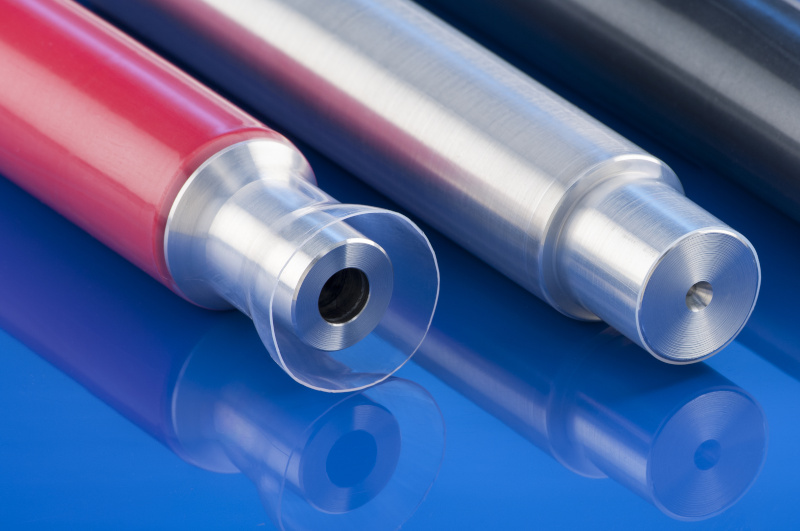
At Adtech, we manufacture FEP and PFA heat-shrinkable roll covers for metal and rubber rollers, providing a durable non-stick surface that can help reduce material build-up, simplify cleaning and protect the roller underneath. Depending on how the roller operates, the cover can also be chemically etched so that it can be bonded securely in place.
So when would you use each option?
First, what is a roll cover doing?
FEP and PFA both have naturally low surface energy, which gives them the non-stick characteristics fluoropolymers are known for.
For a roller, that can be particularly useful where adhesives, coatings, food products, inks, residues or other process materials have a tendency to stick to the roller surface.
Instead of repeatedly stopping machinery to clean build-up from a metal or rubber roller, a fluoropolymer sleeve can provide a smoother release surface.
Roll covers also provide good chemical and corrosion resistance and can be used across a wide temperature range. Adtech roll covers are normally around 0.5 mm thick, providing a more substantial fluoropolymer layer than a very thin sprayed PTFE coating.
The next question is how that cover needs to behave on the roller.
When is a standard heat-shrink roll cover enough?
For many relatively straightforward roller applications, the heat-shrink action of the sleeve provides the required fit.
The sleeve is supplied larger than the roller, positioned over it and then heated so that it recovers around the surface. Shown here in this video
This can be a practical option where the primary requirement is:
- creating a non-stick or release surface
- reducing sticky build-up
- improving chemical resistance
- protecting the underlying roller
- making the cover relatively quick to replace when required
It can also reduce disruption because covers can often be fitted in situ rather than sending the complete roller away for treatment. Adtech supplies standard FEP roll-cover sizes from stock and can also manufacture custom sizes for special applications.
A useful example is a bow roller used by one of Adtech’s paper-processing customers. The 160 mm diameter roller was experiencing sticky residue build-up. A 0.7 mm FEP roll cover was fitted to the 2,500 mm long roller. Because it was not being used as a nip roller, chemical etching and bonding were not required. Full case study here
What does an etched roll cover mean?
This is one area where the terminology can make the specification sound more complicated than it really is.
Fluoropolymers are deliberately difficult to stick to. Their low surface energy gives FEP and PFA their useful release properties, but it also means conventional adhesives struggle to form a strong bond with them.
Chemical etching changes the surface of the fluoropolymer so that an adhesive can grip it more effectively. The treatment can therefore be applied to the inside of a roll cover, while the outside retains the fluoropolymer surface required for the application.
An etched roll cover is therefore normally specified when there is a reason why the sleeve needs to be bonded to the roller.
When should the roll cover be etched and bonded?
Pressure and the forces acting on the cover are important considerations.
Where a roller is continually compressed against another roller or against the material being processed, a simple shrink fit may not always be the most appropriate solution.
A nip roller is a common example. Nip rollers operate as a pair, bringing surfaces together under pressure. Where the cover must remain securely fixed under those conditions, the inside of an FEP roll cover can be supplied etched to assist the bonding process.
The exact bonding system will depend on the roller substrate, operating temperature, pressure and process conditions, so these details should be considered before the cover is specified.
What about transfer, guide and idler rollers?
Transfer, guide and idler rollers generally help move, position or support a web, sheet or product as it passes through a manufacturing line.
Where these rollers are not subjected to significant nip pressure, an unbonded heat-shrink cover may be sufficient if the primary objective is improved release, reduced build-up or easier cleaning.
The important consideration is what the roller actually needs to do.
For example, if the roller relies on surface friction to positively drive a web, adding a very low-friction fluoropolymer surface could change its behaviour. If its job is primarily to guide material while preventing sticking or contamination, those same non-stick properties may be highly beneficial.
This is why specifying a roll cover from the roller name alone is rarely enough.
What is a calender roller?
“Calender” is one of those manufacturing terms that can be unfamiliar if you have not worked with the process before.
A calender normally uses two or more rollers to compress, smooth or control the thickness of material passing between them.
One growing example is lithium-ion battery electrode manufacturing. After electrode material has been coated and dried, it can pass through a calender where opposing rollers compress the electrode to a controlled thickness and density.
That helps explain why roller surface condition matters. Material adhering to a process roller can increase cleaning requirements, interrupt production and potentially affect the material being processed.
However, calender rollers can also operate under considerable pressure and may require very precise surface dimensions. A fluoropolymer roll cover should therefore only be considered after looking at the complete operating conditions, including the permitted change in roller diameter, required surface finish and pressure applied.
In some precision applications a thin applied coating may be more appropriate; in others, a heat-shrinkable cover may provide the required combination of release and durability. The specification has to start with the process.
When would you choose an UltraFit© roll cover?
Not every roller is perfectly cylindrical.
Bow, banana and other curved rollers present an additional challenge because conventional heat-shrink material can change in length as it recovers. On a complex roller profile, this can make achieving a consistent finish more difficult.
Adtech’s UltraFit© fluoropolymer roll covers were developed for these more difficult geometries. They recover without the same length expansion associated with conventional roll-cover material, helping them conform more effectively around curved rollers.
This makes roller geometry another important part of the specification, alongside pressure, temperature and chemical exposure.
FEP or PFA?
Once the roller application has been understood, the fluoropolymer itself can be selected.
FEP is commonly used for roll covers where good release properties, chemical resistance and temperature performance are required. Adtech holds many standard FEP roll-cover sizes in stock.
PFA provides many of the same fluoropolymer characteristics but offers greater temperature capability and flex life. Adtech recommends PFA for more arduous and extremely high-temperature roll-cover applications, with a working temperature up to 250°C compared with 200°C for FEP.
PFA can therefore be worth considering where operating temperature or repeated flexing makes additional durability important.
A simple way to specify the right roll cover
Rather than starting with “Do I need FEP or PFA?”, start with the roller.
- What type of roller is it?
- What material is the roller made from?
- What is its diameter, length and geometry?
- Does it operate under nip or compression pressure?
- What temperature does it experience?
- What substances come into contact with it?
- Is release or non-stick performance the main objective?
- Does the roller require friction to drive the material?
- How precise must the final roller diameter and surface finish be?
- Does the cover need to be permanently bonded?
Those answers normally make the choice between a standard FEP cover, PFA, an etched sleeve, a bonded solution or a more specialised cover much clearer.
Choosing the cover around the application
There is no single roll-cover specification that suits every roller.
A simple guide roller may only need a heat-shrunk FEP sleeve. A high-temperature roller may point towards PFA. A nip roller may require an etched surface so the cover can be bonded securely, while a curved bow roller may benefit from an UltraFit© solution.
For precision applications such as calender rollers, the tolerances and operating conditions need to be understood before deciding whether a heat-shrink cover is appropriate.
At Adtech, our technical team works with customers to understand the roller, the process and the problem they are trying to solve before recommending a fluoropolymer solution. That can include standard FEP and PFA roll covers, made-to-order PFA covers, chemical etching and solutions for more unusual roller geometries.
Need help specifying a roll cover? Talk to Adtech’s technical team about the roller geometry, process conditions and performance you need from the finished surface.