FEP and PTFE belong to the same fluoropolymer family and share many of the properties that make these materials useful in demanding engineering applications: strong chemical resistance, low friction, electrical insulation and stability across a wide temperature range. The important differences are in temperature capability, transparency and how each material can be processed. These differences often determine which material is the more practical choice for a particular component or fluid-handling system.
For a wider introduction to the material family, see Adtech’s PTFE, FEP and PFA comparison. This guide focuses specifically on the decision between FEP and PTFE.
FEP vs PTFE: the quick answer
Choose PTFE when the application needs the higher continuous working temperature, very strong chemical resistance, a low-friction surface and PTFE’s established performance in harsh service conditions.
Choose FEP when you need fluoropolymer chemical resistance together with transparency, greater flexibility or a material that can be melt processed, welded and re-formed more readily.
| Property | FEP | PTFE |
| Adtech working-temperature guidance | -200°C to +200°C | -200°C to +260°C |
| Chemical resistance | Broad resistance across many industrial media | Near-universal resistance to most industrial chemicals |
| Appearance | Clear / highly transparent grades | Typically opaque to translucent |
| Processing | Melt-processable; suitable for conventional extrusion and versatile fabrication | Not conventionally melt-processable; specialist extrusion, moulding and sintering methods are used |
| Flexibility | Particularly flexible in thin-wall tubing | Flexible, but usually selected for other performance priorities |
| Electrical insulation | Excellent | Excellent |
| Typical decision driver | Visibility, formability, lower processing temperature | Higher service temperature, chemical duty, low friction |
Important: working-temperature figures are material guidance rather than an automatic design limit. Pressure, wall thickness, chemical exposure, mechanical loading and sterilisation or cleaning cycles can all affect suitability.
What is FEP?
FEP, or fluorinated ethylene propylene, is a melt-processable fluoropolymer. Adtech specifies FEP where chemical resistance is needed alongside flexibility, transparency or easier fabrication. Its clarity is particularly useful in fluid systems where an operator or instrument needs to see the liquid path, while its processing behaviour allows extrusion, welding and thermoforming into complex shapes.
Adtech supplies both standard and custom FEP tubing, including thin-wall, close-tolerance and fabricated formats for fluidic, medical, analytical and industrial applications.
What is PTFE?
PTFE, or polytetrafluoroethylene, is a fully fluorinated polymer valued for chemical inertness, high-temperature performance, very low friction and strong electrical insulation. PTFE has an exceptionally high melt viscosity, so it is not processed like ordinary melt-flowing thermoplastics. Specialist techniques such as paste extrusion, compression moulding and sintering are used instead.
For applications requiring tubing or sleeving, Adtech offers PTFE tubing in standard and custom sizes, as well as specialist fabrication where a standard straight tube is not enough.
The main differences between FEP and PTFE
1. Temperature capability
Temperature is usually the first practical separator. Adtech’s guidance gives PTFE a working range down to -200°C and up to +260°C, while FEP is listed from -200°C to +200°C. If the component will operate continuously above the FEP range, PTFE is the stronger starting point. Where the application remains below 200°C, other requirements such as visibility, installation method and fabrication may become more important than the extra temperature margin.
2. Chemical resistance
Both materials are chosen for aggressive chemical environments. PTFE provides exceptionally broad chemical resistance and is commonly specified where chemical exposure is the dominant design risk. FEP also performs across a wide range of acids, alkalis and solvents, although material behaviour can become more application-sensitive as temperature rises. Adtech’s PTFE chemical resistance guide and FEP chemical resistance guide should be used as starting points, followed by application testing where failure would be critical.
3. Transparency and visual monitoring
FEP is the clear choice where visual monitoring matters. Its transparency is useful in laboratory systems, analytical equipment, fluid-transfer lines and applications where flow, bubbles, contamination or liquid level need to be observed. PTFE is generally opaque or translucent, so it does not provide the same visibility through the wall of the component.
4. Processing and fabrication
FEP is melt-processable, which makes it easier to extrude, weld and re-form using controlled heat. This is valuable when a design requires bends, swages, flanges, closed ends or welded sections. Adtech’s fluoropolymer thermoforming capability is used to turn standard tubing into application-ready components.
A useful example is Adtech’s custom FEP tube with a 90° bend. The smooth-bore FEP tube was re-formed to create a close-tolerance bend and enlarged connection ends for a fluidic application. PTFE can also be formed and fabricated, but it needs different processing techniques because of its unusual melt behaviour.
5. Low friction and non-stick performance
Low surface energy and low friction are characteristics of both materials. PTFE is particularly well known for its low-friction and non-stick behaviour and is often selected where sliding, release or resistance to build-up is central to the application. FEP also provides a smooth, non-stick surface, which can be useful in fluid transfer, protective covers and encapsulation.
6. Bonding and adhesion
The same non-stick surface that makes both polymers valuable can make adhesive bonding difficult. Where PTFE or FEP needs to be bonded to another substrate, surface treatment may be required. Adtech provides fluoroplastic chemical etching for PTFE, FEP and PFA components to create a bondable surface in selected areas.
Which is better for tubing?
There is no universal winner for tubing. FEP tubing is often better suited to applications where visibility, flexibility, long continuous lengths or post-extrusion forming are important. PTFE tubing is often preferred where the highest service temperature, low friction or very aggressive chemical exposure has greater priority.
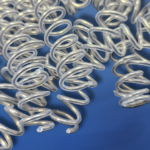
For UVC-related fluid systems, for example, Adtech has used FEP thin-wall tubing to manufacture retractable coils for water sterilisation, taking advantage of the material’s UV transmission and fabrication characteristics. In a different type of chemical application, Adtech used thin-wall PTFE sleeving to encapsulate conical springs while retaining the spring function and providing a chemically resistant barrier.
Which should you choose for heat shrink?
The decision changes when the product form is heat shrink. Recovery ratio, shrink temperature, installation method and the temperature sensitivity of the component all become important. Adtech has a dedicated FEP vs PTFE vs PFA heat shrink guide that compares these materials specifically in heat-shrink applications.
FEP or PTFE for medical and laboratory applications?
Both materials are used in medical, laboratory and analytical equipment, but the selection should be based on the full system. FEP is attractive where a transparent and formable fluid path is useful. PTFE can be preferred where low friction, chemical exposure or higher-temperature service has more influence on performance. Material grade, sterilisation method, extractables requirements and any relevant device or process standards must also be assessed rather than selecting by polymer family alone. Adtech’s medical and pharmaceutical fluoropolymer overview provides further examples of the forms and fabrication methods available.
So, is FEP better than PTFE?
FEP is better when the application benefits from clarity, greater formability and conventional melt processing within its operating range. PTFE is better when the extra temperature capability, very broad chemical resistance and low-friction performance are the stronger design priorities. In many engineering projects the correct choice becomes clear only after temperature, media, pressure, geometry, fabrication and compliance requirements are considered together.
If the requirement falls between standard material choices, Adtech’s R&D and product development team can support material selection, prototyping and fabrication from early concept through to repeat production.
Frequently asked questions
Is FEP the same as PTFE?
No. They are related fluoropolymers with many shared characteristics, but FEP is melt-processable and more transparent, while PTFE has a higher stated working temperature and requires specialist processing.
Can FEP replace PTFE?
Sometimes. If the application stays within FEP’s working-temperature range and benefits from transparency or easier forming, FEP can be a strong alternative. Chemical, pressure and compliance requirements still need to be checked.
Which is more chemically resistant, FEP or PTFE?
Both offer very strong chemical resistance. PTFE is generally the stronger baseline for the most aggressive chemical duty, while FEP remains suitable for a broad range of media. Temperature and exposure conditions can change the result.
Can FEP and PTFE be bonded?
Yes, but their low surface energy makes untreated surfaces difficult to bond. Chemical etching or another validated surface-treatment process is commonly used where adhesive bonding is required.